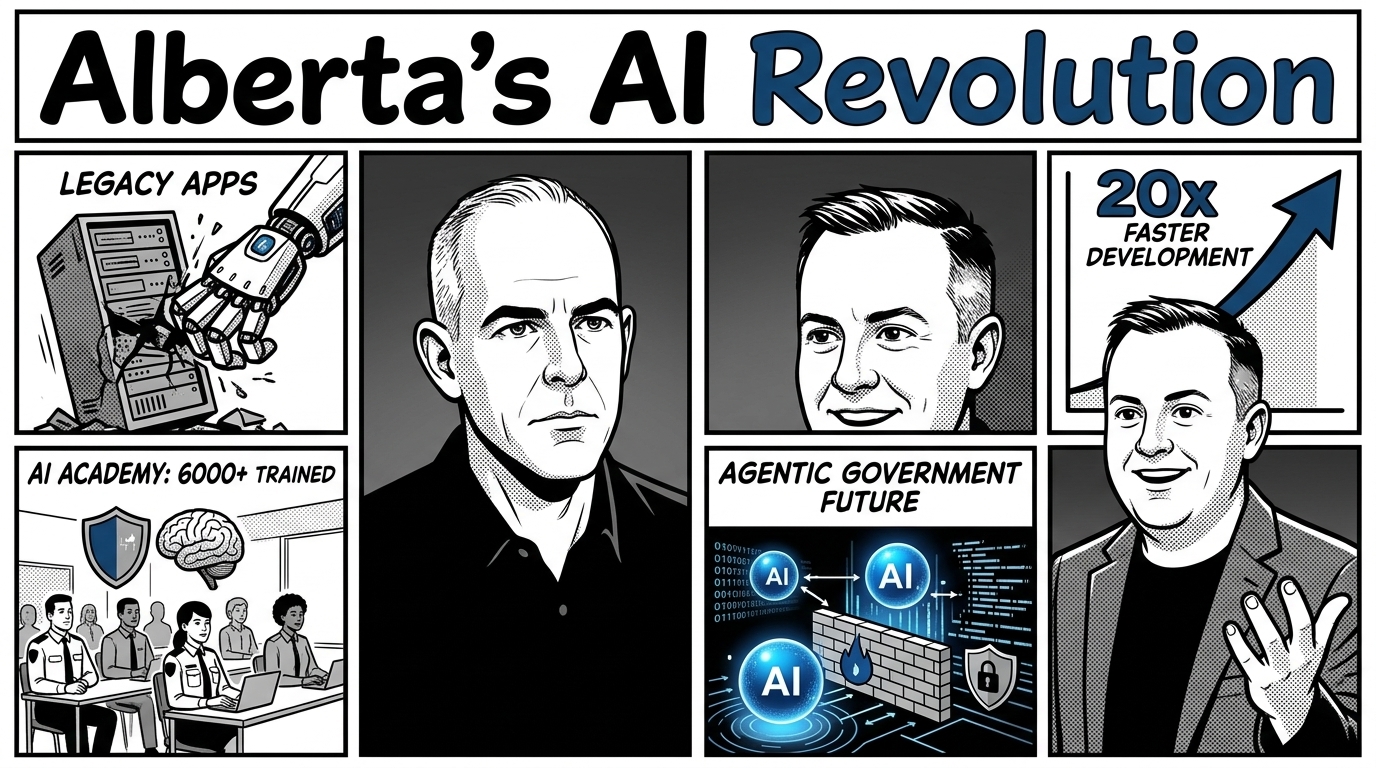
AI is changing how governments work — and Alberta is one of the clearest examples of what that looks like in practice. In this episode, I sat down with Janak Alford, Deputy Minister for the Government of Alberta, to talk about how a relatively small public-sector team is using AI to modernize legacy applications, improve cybersecurity, train thousands of employees, and rethink how digital government should work. It's a follow-up to our earlier conversation on AI in public service — this time with the specifics: the training numbers, the modernization results, and what Alberta is building toward next.
What's Inside
- Why Alberta treated AI as a capacity release valve, not a headcount replacement
- The AI Academy: 6,000+ public servants trained, and the "aha moment" that drives adoption
- The 20x app modernization claim — and why it needs a caveat, not a headline
- "Paint by numbers": how Alberta builds guardrails into AI development instead of reviewing after the fact
- Why Alberta open sources its AI tools, and what "agentic government" looks like next
The result of Alberta's approach isn't simply faster software development. It's a broader shift in how public servants solve problems, how citizens access services, and how publicly funded technology can benefit the wider community.
Alberta Started With a Capacity Problem
Alberta didn't begin its AI journey with a flashy demonstration. It began with a practical challenge: demand for digital services was growing faster than traditional teams could deliver. The province was dealing with legacy applications, technical debt, increasing cybersecurity threats, limited resources, growing demand for digital services, and slow modernization cycles.
Janak explained that Alberta eventually saw AI as a release valve — a way to help existing teams handle more work without simply adding more people or creating larger bureaucratic processes.
"AI was the only release valve that would allow us to keep the people we had and take this challenge on differently."
That distinction matters. Alberta's approach isn't primarily about replacing public servants — it's about giving them better tools, better training, and more capacity to solve difficult problems. The province focused its strategy on four connected goals: modernize legacy applications, improve cybersecurity, train public servants to use AI, and share reusable tools and knowledge through open source.
That's a useful model for any organization beginning its own AI transformation: start with a real operational problem, then use AI to increase capacity where the pressure is greatest.
The Alberta AI Academy Put People First
Before Alberta could scale AI across government, it needed to help people understand and trust the technology — that's where the Alberta AI Academy came in. According to Janak, more than 6,000 public servants have completed the training, including ministers, deputy ministers, assistant deputy ministers, executive directors, technology teams, and staff across government.
The academy runs multiple levels of training focused on practical use cases rather than abstract AI theory — research, policy analysis, application development, digital content, data analysis, workflow improvement, cybersecurity, and training and education.
Janak described the importance of creating an "aha moment" — the point where a person realizes AI can help them solve a problem they previously considered too technical, too large, or too time-consuming. That moment is the foundation of lasting adoption. AI transformation isn't just a technology project; it's also a confidence project. Employees need to believe AI can help them do better work, not simply that management wants them to use a new tool.
Alberta's training approach offers a few lessons worth borrowing directly:
- Train technical and non-technical staff together
- Include senior leadership, not just the technology team
- Connect lessons to real work, not abstract demos
- Give people room to experiment
- Build a shared language around AI across the organization
- Treat adoption as an ongoing capability, not a one-time workshop
The AI Academy also attracted learners outside Alberta, which says something on its own: practical public-sector AI training has relevance well beyond the organization that built it.
The 20x App Modernization Claim
The most attention-grabbing claim in the episode is Alberta's reported improvement in application development and remediation. Janak said that, on certain projects, AI reduced development and remediation time and cost by approximately 20 times, with costs falling to roughly 5% of previous levels.
Worth being direct about this: that's a figure from Alberta's own reported experience on specific projects, not an independently verified industry benchmark. Results will vary depending on the application, requirements, data, security standards, and level of human oversight — the kind of caveat that should travel with any big modernization number, including the ones we cite in our own containerization and app modernization work.
The concrete example from the episode is still striking. A 25-year-old Java application was rebuilt in JavaScript in five days through the AI Academy. Later, a similar application was rebuilt in approximately four hours using multiple AI agents working in parallel — compressing understanding the legacy code, identifying requirements, designing the modern architecture, rebuilding core functionality, applying security and accessibility requirements, testing, and preparing for user acceptance testing into a fraction of the original timeline.
That doesn't mean every legacy application can be modernized in four hours. It shows what becomes possible when experienced people work with capable AI systems, reusable templates, and well-defined standards — the larger lesson being that AI can change the economics of software modernization. Projects that once seemed too expensive or slow to prioritize may become practical to address.
Why Alberta Uses AI Guardrails
Speed alone isn't enough for government technology. Public-sector applications have to meet strict requirements for cybersecurity, privacy, accessibility, documentation, user experience, compliance, and data protection. Alberta's approach is to build these requirements into AI harnesses, templates, and development workflows rather than reviewing for them after the fact.
Janak compared the process to paint by numbers: instead of giving AI a blank canvas and asking it to build anything, Alberta starts with a vetted structure that already reflects government standards, and AI fills in the specific functionality required for the project.
"We're taking the ambiguity away and saying, here's a paint by number, paint within the lines."
This is the same principle behind governance built as a pipeline gate rather than a review meeting — the earlier the standard is defined, the less cleanup an organization does after the fact. It applies to businesses just as much as government: AI works best when you define what "good" looks like before asking the model to produce an outcome. A reliable AI development system needs clear specifications, reusable templates, security requirements, accessibility standards, human review, testing procedures, and documentation rules. The goal isn't to limit AI unnecessarily — it's to focus its capability so it produces results an organization can actually trust and use.
Open Source and Public Benefit
Another central theme in the conversation was Alberta's decision to share more of its work through open source. The province has published white papers, repositories, tools, templates, and AI frameworks so other organizations can learn from and reuse the work when appropriate.
Janak described the Government of Alberta's open-source policy as part of a public-benefit approach: when public money funds useful technology, that technology should be shared whenever there's no legal, privacy, security, or vendor-related reason to keep it private. Open source helps governments avoid rebuilding the same tools repeatedly, share lessons faster, improve transparency, encourage collaboration, let other teams build on existing work, and increase the value of public investment.
Alberta's approach is also based on reciprocity — the province wants others to use and improve its work, then share what they learn in return. That creates a stronger innovation ecosystem than a model where every organization works in isolation.
AI for Cybersecurity and Public Services
Alberta is also using AI as a defensive tool. As AI makes it easier to automate attacks, generate malicious traffic, and identify vulnerabilities, cybersecurity teams have to respond faster — Janak described how Alberta is using AI to protect systems, safeguard data, detect fraud, and respond to new threats.
The province is also using AI to accelerate the delivery of public programs, funding initiatives, and digital portals: launching programs sooner, responding to changing conditions, reducing administrative costs, improving access to services, protecting sensitive information, detecting fraud, and delivering benefits with fewer delays. The key point is that innovation and security don't have to be opposites — with the right guardrails, AI can help organizations move faster while strengthening protection.
AI as a Research and Policy Tool
The Government of Alberta is using AI for more than application development. Teams are also applying it to research policies, regulations, financial information, geospatial data, historical records, and public datasets — analyzing large datasets, comparing policies across jurisdictions, testing assumptions, reviewing proposed regulations, identifying trends, examining public spending, matching entities across datasets, supporting social program planning, and improving data quality analysis.
AI doesn't replace human judgment in this process. It helps people gather, organize, and understand more information before making decisions — the human remains responsible for context, accountability, ethics, and interpretation.
The Future of Agentic Government
The next phase of Alberta's transformation may be the most significant: agentic government. Janak described a future where public servants have multiple AI agents working alongside them — conducting research, reviewing inboxes, checking compliance, analyzing case files, identifying potential fraud, performing quality assurance, preparing reports, monitoring workflows, and recommending next steps. The public servant becomes more like a manager and quality reviewer: defining the desired outcome, setting boundaries, reviewing the work, and making the decisions that matter.
The same concept could change how citizens interact with government. Instead of manually navigating forms, portals, and PDFs, citizens could use an agent that understands their intent and helps complete routine tasks — renewing a license, applying for a public program, checking eligibility, submitting required information, tracking an application, receiving reminders, completing routine forms. The goal isn't to remove people from the process; it's to reduce unnecessary friction and bring humans in when judgment or a meaningful decision is needed.
From Forms to Outcomes
One of the strongest ideas in the episode is the shift from process-focused government to outcome-focused government. Traditional systems often revolve around forms, portals, applications, case management tools, email submissions, separate databases, and manual approvals. But citizens aren't really asking for forms — they're asking for outcomes: receiving a benefit, renewing a service, accessing information, solving a problem.
AI creates an opportunity to redesign services around the result instead of the process. Janak argued that downloading a PDF, completing it, and emailing it back isn't true digital government — real digital government understands what a person needs and helps deliver that outcome with as little friction as possible. It's a first-principles approach: instead of asking "how can we improve this form," the question becomes what outcome this program is supposed to deliver, and how to achieve it more simply.
Reducing Technical Debt
The episode also explored the possibility of systems that can self-patch, self-heal, and self-evolve under human oversight. Organizations everywhere are slowed down by legacy code, outdated databases, old frameworks, incomplete documentation, difficult-to-maintain applications, security vulnerabilities, and disconnected systems. AI can help teams understand old code, identify risks, generate documentation, modernize components, test applications, and build replacements.
The objective isn't to pretend legacy systems disappear overnight — it's to create a realistic way to reduce the burden they create, moving away from systems that become more expensive and fragile every year.
Why AI Is a Productivity Imperative
Near the end of the conversation, Janak made a broader argument about Canada's economic future. He warned that public discussions about AI often focus on fear, risk, and worst-case scenarios — those issues deserve attention, but so does the productivity opportunity. Even modest improvements compound over time: a 5% productivity improvement repeated across industries and over many years could create a major difference in economic output, service delivery, and organizational capacity.
"AI is the era of the entrepreneur."
For individuals and smaller organizations, AI can reduce bureaucracy, automate repetitive work, and create more time for creativity and problem-solving.
What Leaders Can Learn From Alberta
Alberta's approach offers several lessons for any organization beginning an AI transformation:
- Start with real problems — application modernization, slow workflows, cybersecurity, customer service, or another measurable operational need.
- Train people broadly — AI adoption can't depend on a small technical group. Leaders, managers, and frontline workers all need practical experience.
- Build guardrails before scaling — define security, privacy, accessibility, and quality standards before asking AI to generate critical work.
- Create reusable templates — the more repeatable the process, the easier it is to scale AI safely.
- Keep humans accountable — AI can support decisions and workflows, but people remain responsible for judgment, ethics, context, and oversight.
- Share what can be shared — open source can multiply the value of publicly funded or internally developed work.
- Design around outcomes — don't simply automate old forms and processes. Ask what the user actually needs to accomplish.
Alberta's AI Transformation Is a Story About People
The reported 20x improvement in some app development and remediation workflows is one of the most compelling details from the episode, but the deeper change is cultural: Alberta is encouraging people to rethink what's possible.
"We're using pre-AI brains to solve post-AI problems."
That may be the central challenge for every organization today — not to make yesterday's process a little faster, but to rethink the process entirely. It's the same pattern we see building governed agent platforms for enterprise and public-sector clients: the technology is rarely the constraint. The constraint is whether governance, training, and reusable structure get built in from the start.
Ready to explore what AI could change in your organization? Start by identifying one slow, repetitive, or high-friction workflow. Define the outcome you want, document the standards that must be protected, and test whether AI can help your team deliver that outcome faster and more effectively.
Have a legacy modernization or AI governance question after listening? Book a discovery call or join our Discord community. Catch every episode on the Code To Cloud podcast page, including our earlier conversation with Janak Alford on AI in public service.
Kevin Evans
 Fractional CTO & Founder, Code To Cloud Inc.
Kevin Evans is a fractional CTO and technology advisor based in Calgary, Alberta, who leads enterprise and mid-market cloud and AI engagements and hosts the Code To Cloud podcast. More about Kevin
Fractional CTO & Founder, Code To Cloud Inc.
Kevin Evans is a fractional CTO and technology advisor based in Calgary, Alberta, who leads enterprise and mid-market cloud and AI engagements and hosts the Code To Cloud podcast. More about Kevin
Frequently Asked Questions
What is the Alberta AI Academy?
The Alberta AI Academy is the Government of Alberta's internal training program for public servants on practical AI use — research, policy analysis, application development, data analysis, and cybersecurity. More than 6,000 public servants have completed it, spanning ministers, deputy ministers, technology teams, and frontline staff.
Is Alberta's claim of 20x faster application development independently verified?
No — it's a figure Janak Alford described from Alberta's own reported experience on specific projects, not an independently verified industry benchmark. Results depend heavily on the application, requirements, data, security standards, and level of human oversight, which is worth stating plainly rather than repeating the number as a universal guarantee.
What are AI guardrails, and why does Alberta build them into development?
AI guardrails are the security, privacy, accessibility, and compliance requirements built directly into the templates and harnesses AI works within, rather than reviewed after the fact. Janak Alford calls it "paint by numbers" — AI fills in functionality inside a pre-vetted structure instead of starting from a blank canvas, which is what makes the output something a government can actually trust and ship.
What is "agentic government"?
Agentic government is Janak Alford's term for public servants working alongside multiple AI agents that handle research, compliance checks, case file analysis, and report preparation, while the person acts as manager and reviewer — defining outcomes, setting boundaries, and making the decisions that need human judgment. The same idea extends to citizens interacting with an agent instead of navigating forms and portals directly.
Why does Alberta open source its AI tools and templates?
Janak Alford frames it as a public-benefit policy: when public money funds useful technology, that technology should be shared whenever there's no legal, privacy, security, or vendor-related reason to keep it private. It avoids other governments rebuilding the same tools, and the reciprocity — others using and improving the work — builds a stronger ecosystem than everyone working in isolation.